

Update: Jonathan Anomaly, director of scientific research and communication for Herasight and whose articles I criticize here, responds in a detailed comment. I recommend reading his response together with this post. Anomaly’s role in the company has also been clarified.
Multiple commercial companies are now offering polygenic embryo selection on a wide range of traits, including genetic predictors of behavior and IQ. I’ve previously written about the methodological unknowns around this technology but I haven’t commented on the ethics. I think having a child is a very personal decision and it’s not my place to tell people how to do it. But the new embryo selection company, Herasight, has started advocating for eugenic societal norms that I find disturbing and worth raising alarm over. Because this is a fraught topic, I’ll start with some basic definitions.
What is eugenics?
Eugenics is an ideology that advocates for conditioning reproductive rights on the perceived genetic quality of the parents. Francis Galton, the father of eugenics, declared that eugenics’ “first object is to check the birth-rate of the Unfit, instead of allowing them to come into being”. This goal was to be achieved through social stigma and, if necessary, by force. The Eugenics Education Society, for instance, advocated for education, segregation, and — “perhaps” — compulsory sterilization to prevent the “unfit and degenerate” from reproducing:

A core component of defining “the unfit” was heredity. Eugenicists are not just interested in improving people’s phenotypes — a goal that is widely shared by modern society — but the future genotypic distribution. The genetic stock. This is why eugenic policies historically focus on sterilization, including the sterilization of unaffected relatives who harbor genotype but not phenotype. If someone commits a crime, they face time in prison for their actions, but under eugenic reasoning their law-abiding sibling or child is also suspect and should be stigmatized (or forcefully prevented) from passing on deficient genetic material.
A simple two-part test for eugenics is then: (1) Is it concerned with the future genetic stock? (2) Is it advocating for restricted reproduction, either through stigma or force, for those deemed genetically inferior?
Is embryo selection eugenics?

I have publicly resisted applying the “eugenics” label to embryo selection writ large and I continue to do so. Embryo selection is a tool and its use is morally complex. A couple can choose to have embryo screening for a variety of reasons ranging from frivolous (“we want to have a blue eyed baby”) to widely supported (“we carry a recessive mutation that would be fatal in our baby”), none of which have eugenic intent. Embryo selection can even be an anti-eugenic tool, as in the case of high-risk couples who have already decided against having children. If embryo selection technology allows them to lower the risk to a comfortable level and have a child they would otherwise have avoided, then the outcome is literally the opposite of eugenic selection: “unfit” individuals (at least as they see themselves) now have an incentive to produce more offspring than they would have. In practice, IVF remains a physically and emotionally demanding procedure, and my guess is that individual eugenic intentions — the desire to select out unfit embryos with the specific motivation of improving the “genetic stock” of the population — are exceedingly rare.
Is Herasight advocating for eugenics?
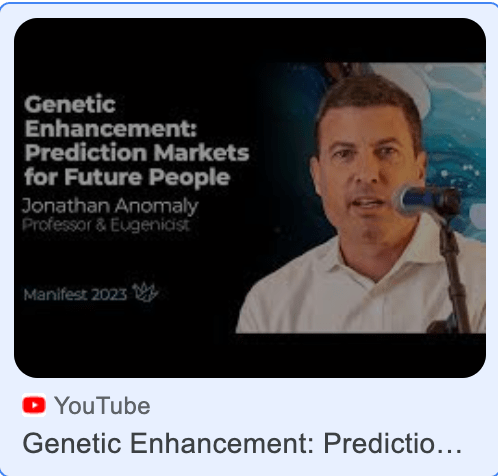
While I do not think embryo selection is eugenic in itself, like any reproductive technology, it can be wielded for eugenic purposes. The new embryo selection company Herasight, in my opinion, is advocating for exactly that. To understand why, it is useful to first understand the theories put forth by Herasight’s director of scientific research and communication Jonathan Anomaly (in case you’re wondering, that is a chosen last name). Anomaly is a self-proclaimed eugenicist [Update: Anomaly has clarified that this description was not provided by him and he requested that it be removed]:
Prior to joining Herasight, Anomaly wrote extensively on the ethics of embryo selection, notably in a 2018 article titled “Defending eugenics”. How does Anomaly defend eugenics? First, he reiterates the classic position that eugenics is a resistance to the uncontrolled reproduction of the “unfit” (emphasis mine, throughout):
Darwin argued that social welfare programs for the poor and sick are a natural expression of our sympathy, but also a danger to future populations if they encourage people with serious congenital diseases and heritable traits like low levels of impulse control, intelligence, or empathy to reproduce at higher rates than other people in the population. Darwin feared that in developed nations “the reckless, degraded, and often vicious members of society, tend to increase at a quicker rate than the provident and generally virtuous members”
Anomaly goes on to sympathize with Darwin’s position and that of the classic eugenicists, arguing that “While Darwin’s language is shocking to contemporary readers, we should take him seriously”, later that “there is increasingly good evidence that Darwin was right to worry about demographic trends in developed countries”, and that we should “stop allowing [the Holocaust] to silence any discussion of the merits of eugenic thinking”.
Anomaly then proposes several potential eugenic interventions, one of which is a “parental licensing” scheme that prevents unfit parents from having children:
The typical response is for the state to step in and pay for all of these things, and in extreme cases to remove children from their parents and put them in foster care. But it would be more cost-effective to prevent unwanted pregnancies than treating their consequences, especially if we could achieve this goal by subsidizing the voluntary use of contraception. It may also be more desirable from the standpoint of future people.
The phrase “future people” figures repeatedly in Anomaly’s writing as a euphemism for the more conventional eugenic concept of genetic stock. This connection is made explicit when he explains the most compelling reason for supporting parental licensing:
The most compelling reason (though certainly not a decisive reason) for supporting parental licensing is that traits like impulse control, health, intelligence, and empathy have significant genetic components. What matters is not just that some parents are unwilling or unable to take care of their children; but that in many cases they are passing along an undesirable genetic endowment.
What are we really talking about here? Anomaly has proposed a technocratic rebranding of eugenic sterilization: instead of taking away your reproductive rights clinically, the state will take away your reproductive license and, if you still have children, impose “fines or other costs” (though Anomaly does not make the “other costs” explicit, eugenic sterilization is mentioned as an example in the very next sentence). How would the state decide who should lose their license? Anomaly explains:
For a parental licensing scheme to be fair, we would need to devise criteria that are effective at screening out only parents who impose significant risks of harm on their children or (through their children) on other people.
A fundamental normative principle of our society is that all members are created equal and endowed with unalienable rights. What Anomaly envisions instead is a society where the state can seize one of the most intimate of human freedoms — the right to become a parent — based on innate factors. How does the state determine whether a future child imposes significant risk on future people? By inspecting the biological makeup of the parents and identifying “undesirable genetic endowments” that will harm others “through their children”. This is a policy built explicitly on genetic desirability and undesirability, where those deemed genetically unfit are stripped of their rights to have children and/or fined for doing so — aka bog-standard coercive eugenics.
Today, Anomaly is the spokesperson for a company that screens parents for “undesirable genetic endowments” and, for a price, promises to boost their genetic desirability and their value to future people. It is easy to see how Herasight fits directly into the eugenic parental licensing scheme Anomaly proposed. Having an open eugenicist as the spokesperson for an embryo selection company seems, to me, akin to hiring Hannibal Lecter to do PR for a hospital, but perhaps Anomaly has radically changed his views since billing himself as a eugenicist in 2023?
Herasight (with Anomaly as first author) recently published a perspective white-paper on the ethics polygenic selection, from which we can glean their corporate position. The perspective outlines the potential benefits and harms of embryo selection. The very first positive benefit listed? The “benefits to future people”. While this section starts with a focus the welfare of individual children, it ends with the same societal motivations as classical eugenics: the social costs of the unfit on communities and the benefits of the fit to scientific innovation and the public good:
Healthier people also tend to have positive externalities for other people with whom they share the planet. People with a healthier immune system are less likely to transmit infectious diseases, and those with fewer illnesses will impose fewer social costs on families and communities.
A similar case could be made for intelligence. Brighter people tend not only to earn more income and education, which is good for them (Ritchie, 2015). But they also tend to contribute more to scientific innovation (Shulman and Bostrom, 2014) and to public goods, which affects the quality of the institutions that we share (Kanyama, 2014). It is obvious why smarter people tend to excel in science and other intellectual arenas. But the reason they exhibit more cooperative behavior in competitive situations like prisoner’s dilemma and public goods games – situations where there are immediate personal gains from defection, but larger gains in the future from cooperation – seems to derive from the fact that intelligence is positively correlated with patience and self-control (Jones, 2015). These considerations give us moral reasons to allow parents to select against disease and in favor of intelligence (Anomaly and Jones, 2020).
It is worth noting that the cited work (Anomaly and Jones, 2020) is specifically aimed at “political institutions and public policies”. This is the first component of eugenics. What about restricted reproduction? An echo of the parental licensing idea permeates the discussion of potential harms:
However, some governments might opt for sticks rather than carrots, and mandate that parents who use IVF must screen for diseases or risk losing insurance benefits or state-funded healthcare. This could, in principle, also lead to social stigma and discrimination.
We think this hypothetical scenario is extremely unlikely to materialize, especially in the next few decades. … And we don’t see any movement by governments or insurance companies to force couples to use this technology, or any discrimination against children whose parents fail to use it.
Parents, however, are a different issue. For example, if parents know they are carriers for a gene that causes a catastrophic monogenic disease like Tay Sachs, they might be considered blameworthy for not revealing this to their partner, or disregarding these risks when deciding to have children. In this case, the parents, not the child, might be stigmatized. And this is appropriate.
This is a genuinely bizarre sequence of claims. It starts off by acknowledging that governments may punish parents for not using genetic selection. Then it argues that there is no movement for such a policy, omitting the fact that Anomaly himself has advocated for it. Then it pivots back to the possibility of discrimination and stigmatization of parents who do not use genetic selection and argues that, in fact, stigmatization is appropriate! In other words, Herasight is advocating for a social norm of stigmatizing parents who choose to reproduce if they are deemed genetically “unfit”. I’ve never seen anything like this before in a corporate white-paper and I initially thought it had to be a mistake.
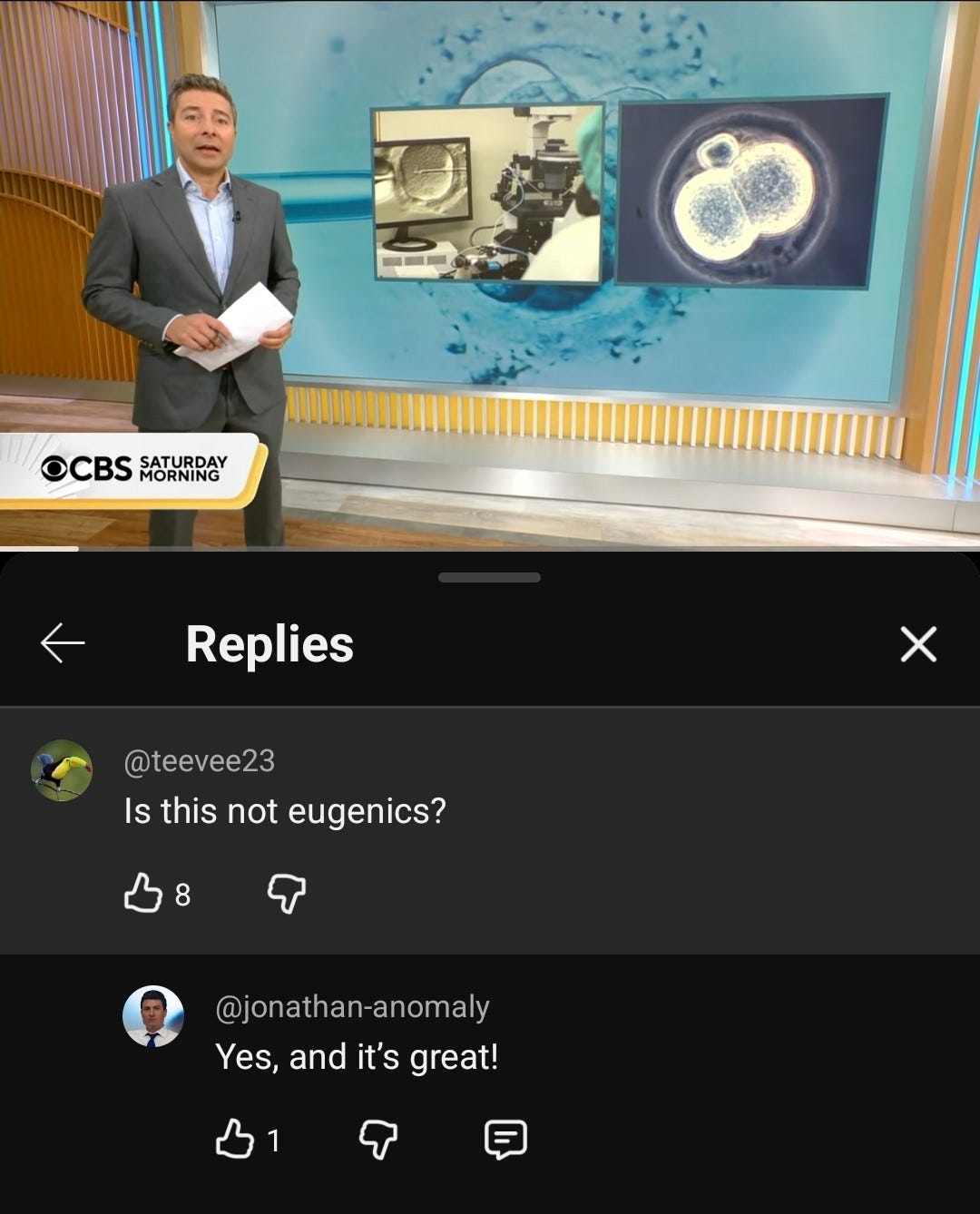
But recently, the possibility that this was just a badly worded slip-up was dispelled. After a CBS News piece on Herasight was posted to YouTube, a concerned commenter asked “Is this not eugenics?”. Jonathan Anomaly helpfully popped in to the comment section to clarify: “Yes, and it’s great!”
When eugenics goes mainstream
Let’s review: eugenics has as a goal of limiting the birthrate of the “unfit” or “undesirable” for the benefit of the group. Anomaly describes himself as a eugenicist and explicitly echoes this goal through, among other policies, a parental licensing proposal. Anomaly now runs a genetic screening company. The company recently published a perspective paper advocating for the stigmatization of “unfit” parents who do not screen. Anomaly, as spokesperson, reiterates that their goal is indeed eugenics — “Yes, and it’s great!”. With any other person one could argue that they were clueless or trolling; but if anyone knows what eugenics means, it is a person who has spent the past decade defending it.
I have to say I am floored by how strange this all is. My personal take on embryo selection has been decidedly neutral. I think the expected gains are limited by the genetic architecture of the traits being scored and the companies are mostly fudging the numbers to look good. As noted above, I also think a common use of this technology will be to calm the nerves of parents who otherwise would have gone childless. So I have no actual concerns about changes to the genetic make-up of the population or genetic inequality or any of the other utopian/dystopian predictions. But I am concerned that the marketing around the technology revives and normalizes classic eugenic arguments: that society is divided into the genetically fit and the genetically unfit, and the latter need to be stigmatized away from parenthood for the benefit of the former. I am particularly disturbed by the giddiness with which Anomaly and Herasight have repeatedly courted eugenics-related controversy as part of their launch campaign.
Even stranger has been the response, or rather non-response, from the genetics community. Social science geneticists and organizations spent the past decade writing FAQs warning against the use of their methods and data for individual prediction and against genetic essentialism. Many conference presentations and seminars start with a section on the sordid history of eugenics and the sterilization programs in the US and Nazi Germany, vowing not to repeat the mistakes of the past. Now, a company is openly advocating for eugenics (in fact, a company with direct connections to these social science organizations) and these organizations are silent. It is hard not to conclude that the FAQs and warnings were just lip service. And if the experts aren’t raising alarms, why would the public be alarmed?
I am not the only person who has been surprised by the muted reaction. Commenters immediately noticed the strange choice to defend Galtonian eugenics in Herasight’s marketing. Eric Turkheimer pointed it out in his blog when Herasight went public. James Lee made a similar observation at the tail end of a recent debate with Anomaly: that he was surprised by the lack of opposition and that opposing this technology would now be the main focus of his own work. I am certain Turkheimer, Lee, and I all disagree on many things, but I have a great deal of respect for plainly stating the truth as one sees it. There are now multiple commercial options available for embryo screening offering a similar menu of services. I do not see how someone can, in good conscience, support or work with the one company that is explicitly eugenic in its stated goals.
About a decade ago, I was invited to participate in a debate on the topic “eugenics: for and against.” The contribution that I published was called “Defending Eugenics: from cryptic choice to conscious selection.”
As Dr Gusev rightly points out, “eugenics” is a fraught term with many meanings. In a recent book called The Ethics of the New Eugenics, "eugenics" is defined as “strategies or decisions aimed at affecting, in a matter which is considered to be positive, the genetic heritage of a child, a community, or humanity in general.” Sounds sensible to me. However, the term “eugenics” is increasingly used as a curse word by people who don’t like genetic explanations of behavior – for example, Professors Paige Harden and Gregory Clark have been called “eugenicists” for studying the genetics of intelligence.
Given the confusion, it can be helpful to stipulate a definition of the sort I gave in the first paragraph of my paper: “eugenics can be thought of as any attempt to harness the power of reproduction to produce future people with traits that enable them to thrive.” Gusev, however, ignored my definition in his post and instead framed eugenics in terms of a substantive policy goal that Galton proposed, and that I reject. Gusev is free to use whatever definition he wants, but he should not assume I endorse it in the same way that, from the fact that Gusev would likely call himself “pro-choice” in the abortion debate, I would not assume that he shares every policy goal Margaret Sanger advanced (Sanger founded Planned Parenthood, and supported coercive eugenics to combat criminality).
Gusev goes on to mention a definition that I (and my co-authors at Herasight) adopt from Leonard Darwin: “eugenics is the study of the study of heredity as it may be used for the betterment, mental and physical, of the human race.” This definition is appealing because it includes both morally innocent forms of “eugenics,” such as mate selection and embryo selection, as well as morally abhorrent forms, such as forced sterilization and mass murder. I think it’s important to select a neutral use of the term so that we can assess the merits of specific policies and principles, rather than using a version of the term that biases it one way or the other.
Gusev criticizes the fact that the definition of “eugenics” we use from Leonard Darwin comes from a historical document which summarizes a meeting of the English Eugenics Society in which sterilization is considered as a potential policy option. There are two points to be made here:
First, borrowing a definition from the president of the Eugenics Society – surely an authority on the topic! – does not commit us to endorsing anything in particular that some members of the Eugenics Society believed.
Second, contrary to what Gusev claims, the issue that members of the eugenics society seem to have been discussing in the pamphlet in question is *voluntary* sterilization, not compulsory sterilization. I have no interest in defending either policy, but it’s worth pointing out that voluntary sterilization exists in both the US and UK: although it is rare, it is occasionally offered to people with severe mental illness who cannot care for themselves and who worry about getting pregnant, or to violent criminals in exchange for a reduced prison sentence (in this case it’s called “chemical castration”). Still, the important point is that we cite the pamphlet’s definition of “eugenics,” not that we endorse anything members of the society said at a particular meeting.
Gusev goes on to suggest that I support parental licensing. This is false. Toward the end of my debate essay I explored a rationale for parental licensing, since two of the two most influential political philosophers of the last 200 years – John Stuart Mill and John Rawls – seem to endorse restrictions on reproduction that are deemed to be socially beneficial. It should go without saying, however, that developing the most charitable version of an argument before criticizing it is not the same thing as accepting the argument. The point of a philosophy paper, as I see it, is to carefully evaluate arguments and see where their strengths and weaknesses are – to question received wisdom and provoke thought, not to chant slogans or defend platitudes.
In another part of his post, Gusev describes as “bizarre” the claim that social stigma is an acceptable tool to discourage terrible choices. While my co-authors and I agree that we should be quite careful not to stigmatize reasonable choices, we disagree that stigma has no place in the reproductive realm. As we argue in our ethics paper, stigma shouldn’t be directed at the disabled. But it could legitimately be directed at people who make awful choices on behalf of their future children, such as women who drink alcohol during pregnancy or parents who use IVF and have multiple embryos but who – as we say in our paper – “knowingly impose a horrific genetic disease like Tay Sachs on their children.” Sasha may disagree with this, but it’s not an especially controversial claim to think parents who choose to deliberately impose a grave disability on their future children are worthy of social stigma.
Finally, Gusev posts an old screenshot that suggests that I call myself a professor of eugenics. The screenshot is from a video that was captioned by a young guy named Austin Chen (who hosted a conference I spoke at on prediction markets). When he captioned the video, Austin wrote my title as “Dr. Anomaly, professor and eugenicist,” when he apparently meant “Dr Anomaly, professor and geneticist.” A silly mistake that made me laugh, but which I asked him to change a couple of years ago. Gusev somehow found the old screenshot and posted it. This is such a trivial detail that there’s no point dwelling on it. But it is emblematic of a broader pattern in Gusev’s post: the inference from cherry-picked statements, slippery definitions, and spurious screenshots that Dr Anomaly is, in fact, the supervillain that his name suggests.
I don't think that Anomaly supports coercive eugenics. Isn't he on the record saying the opposite? The extent of his "coercive eugenics" seems to be ... stigmatizing knowingly giving birth to a child with a high risk of Tay-Sachs, yes? Tay-Sachs has been essentially eliminated in the Ashkenazi population via genetic screening, right?